
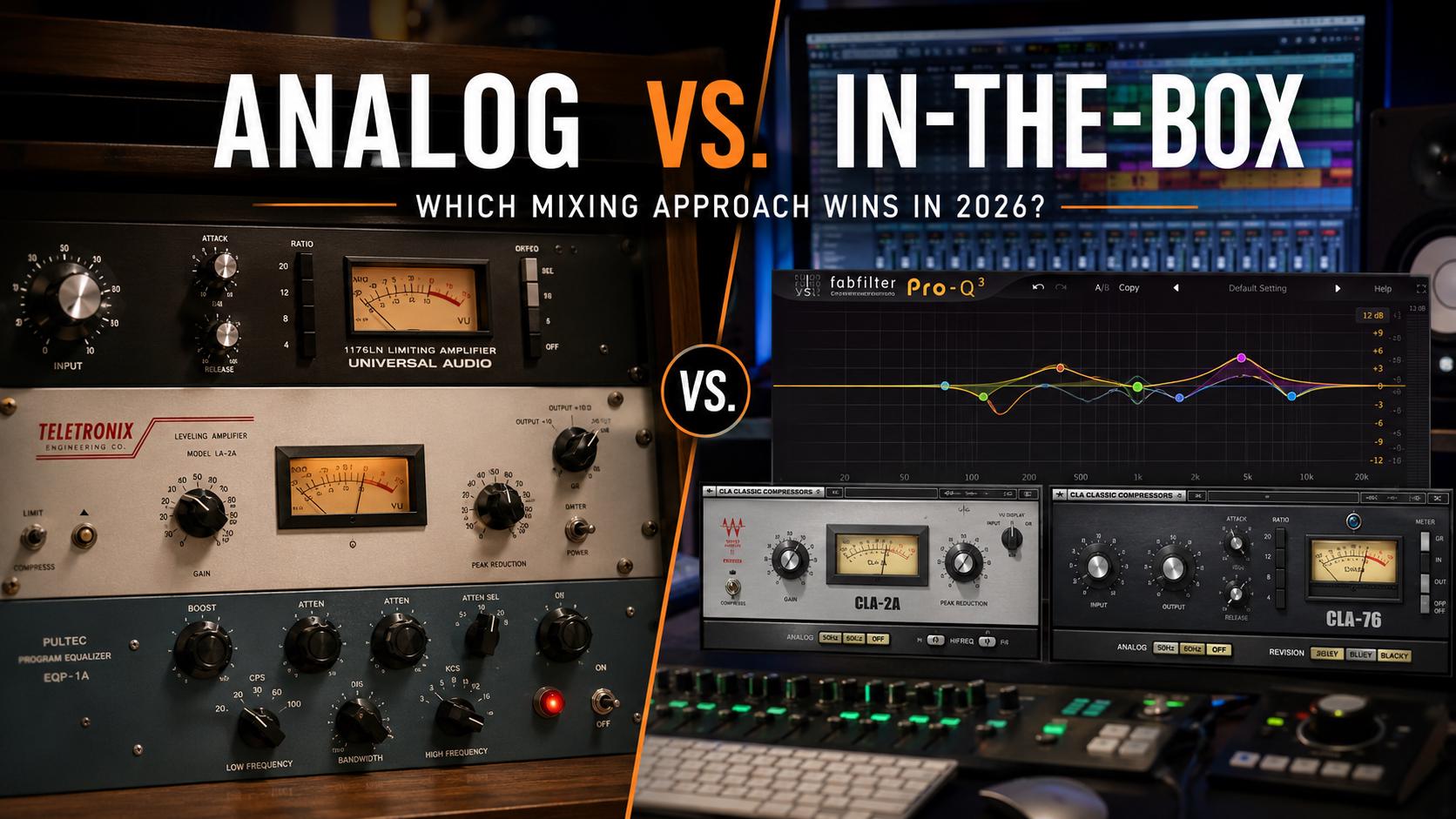
When producers search for the best mixing tools, one debate still dominates forums, YouTube videos, Reddit discussions, and studio conversations: analog hardware versus in-the-box mixing with plugins. Some engineers swear that nothing can replace the warmth and depth of real analog gear. Others argue that modern plugins have become so advanced that the difference is now almost impossible to hear in a finished mix.
The truth is that both approaches have evolved massively over the past decade. Modern plugins sound better than ever, while analog gear remains deeply respected for its musical character and tactile workflow. Whether you produce hip-hop, EDM, cinematic music, rock, metal, lo-fi, or pop, understanding how both worlds work can help you make smarter decisions about your studio setup, your workflow, and your sound.
One reason this topic keeps trending is because people are constantly searching for legendary equipment like the 1176 compressor, LA-2A, Pultec EQP-1A, SSL bus compressor, and Neve preamps. At the same time, searches for FabFilter Pro-Q, Waves CLA-76, Valhalla VintageVerb, and analog emulation plugins continue to explode. Producers want to know whether they should invest thousands into hardware or simply work entirely inside their DAW with plugins.
The answer is not as black-and-white as many people think.
Why Analog Mixing Still Has a Legendary Reputation
Analog mixing became legendary because countless classic records were built using physical hardware. Before digital audio workstations existed, engineers relied on large consoles, tape machines, outboard compressors, and analog EQs to shape sound. These devices did more than simply process audio. They introduced subtle imperfections that many people now associate with warmth, glue, punch, and musicality.
One of the most famous examples is the Universal Audio 1176 compressor. Even producers who are new to mixing eventually encounter the 1176 because it appears everywhere in music production culture. The reason it became so respected is because of its aggressive character and incredibly fast response. Vocals become more energetic, drums feel punchier, and bass guitars suddenly gain movement and presence. Engineers have used the 1176 on everything from rock vocals to modern trap drums.
The LA-2A sits on the opposite side of the compression spectrum. Instead of sounding aggressive and energetic, it feels smooth and polished. Its optical compression design reacts more slowly and musically, which is why so many engineers use it for vocals and bass. The famous “1176 into LA-2A” vocal chain is still discussed constantly online because it combines speed and smoothness in a way that simply works.
Then there is the Pultec EQP-1A, one of the most searched analog EQs in history. Producers love it because it shapes sound differently than surgical digital EQs. Rather than making precise corrections, the Pultec adds broad musical tone. Its famous low-end boost trick can make kick drums and bass feel huge without sounding muddy. Many mastering engineers still rely on Pultec-style EQs because they enhance sound in a very natural way.
Part of the obsession with analog gear comes from the way analog circuitry behaves. Tubes, transformers, transistors, and tape machines all introduce harmonic saturation and tiny nonlinearities that subtly change the sound. These imperfections create movement and depth that many people describe as “alive.” That is why searches like “analog warmth,” “tape saturation,” and “how to sound analog” continue to trend every year.
What many beginners do not realize is that analog workflow also changes how engineers make decisions. When working with limited hardware, you cannot endlessly load new plugins or constantly undo choices. Engineers often commit earlier and trust their instincts more. Ironically, these limitations can actually improve creativity and productivity because they reduce option paralysis.
At the same time, analog mixing comes with very real disadvantages that beginners often underestimate. Hardware is expensive, takes up physical space, requires maintenance, and complicates workflow. A single high-end compressor can cost more than an entire plugin collection. Real studios also require cabling, patch bays, converters, acoustic treatment, and proper electrical management. Suddenly, what seemed glamorous on YouTube becomes extremely expensive in reality.
Another major challenge is recall. When working inside a DAW, reopening a project instantly restores every setting. Analog hardware does not work that way. Knobs move, settings get forgotten, and recreating old mixes becomes time-consuming. This is one of the biggest reasons why many modern producers shifted toward digital workflows.
Latency is another hidden issue many people ignore when building hybrid or analog-heavy setups. Routing audio through hardware introduces extra conversion stages and signal paths. In large sessions, managing this correctly can become complicated, especially for producers working quickly under deadlines.
Why In-the-Box Mixing Took Over Modern Music Production
In-the-box mixing transformed the music industry because it made professional production accessible to almost everyone. Today, producers can create commercially competitive mixes inside laptops using nothing more than plugins and headphones. That would have sounded impossible twenty years ago.
The rise of plugins like FabFilter Pro-Q completely changed expectations around digital mixing. Pro-Q became incredibly popular because it solved real-world mixing problems quickly and efficiently. Instead of slowly sweeping frequencies on hardware EQs, engineers could visually identify harsh resonances, apply dynamic EQ, work in mid/side mode, and make incredibly precise adjustments within seconds. The workflow became dramatically faster.
This is one of the biggest reasons plugins became dominant. Modern producers often work under deadlines. Whether someone creates music for Spotify releases, YouTube content, sync licensing, or client work, speed matters. Plugins allow engineers to move quickly, automate parameters instantly, save presets, and recall sessions perfectly every single time.
Cost is another huge factor. A professional analog studio can easily cost tens or even hundreds of thousands of euros. Meanwhile, plugin companies now offer world-class tools for a tiny fraction of that price. Producers can access convincing emulations of legendary hardware without needing large rooms or massive budgets.
What surprises many people is just how good modern analog emulation plugins have become. Tools like the Waves CLA-76, UAD 1176 Collection, Softube Tube-Tech CL 1B, and Soundtoys Decapitator recreate analog-style saturation and compression incredibly well. In blind listening tests, many people struggle to consistently identify whether a mix used real analog hardware or plugins.
That reality changed the industry completely.
Modern producers now combine transparent digital tools with analog-style coloration plugins to create workflows that are flexible, affordable, and sonically impressive. A producer might use FabFilter Pro-Q for precise cleanup, then apply a tape saturation plugin afterward to add warmth and movement. This combination of clean digital precision and analog-inspired character became the modern standard.
Reverb plugins are another area where digital processing evolved dramatically. Valhalla VintageVerb became one of the most beloved plugins in music production because it delivers lush vintage-style reverbs without the massive cost of classic hardware units like the Lexicon 224. Instead of needing giant racks of studio gear, producers can now load multiple high-quality reverbs instantly inside a DAW session.
The same thing happened with saturation plugins. In the past, engineers relied on tape machines and analog consoles to add harmonic richness. Today, plugins like FabFilter Saturn, Black Box HG-2, and Waves J37 simulate those behaviors extremely convincingly. Many modern mixes rely heavily on saturation plugins to create depth and density.
Another reason plugins dominate modern production is flexibility during revisions. Clients often ask for endless changes. A vocalist may want the chorus brighter, the label may request louder drums, or an artist may suddenly decide the reverbs feel too dark. Inside a DAW, these changes can happen within minutes. In a fully analog workflow, revisions often become far slower and more technical.
CPU power also changed the game dramatically. Years ago, producers had to freeze tracks constantly because computers struggled with large plugin chains. Modern systems can now run hundreds of instances of advanced analog emulation plugins simultaneously. This allowed fully digital studios to compete sonically with traditional recording environments in ways that were previously impossible.
The Real Difference Between Analog and Plugins
One of the biggest misconceptions in music production is that analog gear automatically sounds “better.” In reality, the differences are often smaller than people expect, especially in the context of a full mix.
What truly separates professional mixes from amateur ones is rarely the gear itself. More often, it comes down to arrangement, balance, automation, monitoring accuracy, and engineering decisions. A talented mixer using stock plugins can absolutely outperform an inexperienced engineer working inside a million-euro studio.
Monitoring matters far more than most producers realize. Many beginners obsess over compressors and EQs while mixing in untreated bedrooms with poor acoustics. Even the best analog gear cannot compensate for inaccurate monitoring. Professional engineers often invest heavily into room treatment and speaker placement because hearing accurately is more important than owning expensive hardware.
There is also a psychological aspect to analog gear that people rarely discuss. Hardware often forces slower, more intentional decisions. When an engineer reaches toward a physical compressor or EQ, the process feels tactile and focused. Plugins, on the other hand, can encourage endless tweaking because every parameter is instantly accessible.
Some producers actually become less productive inside fully digital environments because the possibilities never end. Modern DAWs offer thousands of plugin choices, presets, routing options, and automation capabilities. While this flexibility is powerful, it can also overwhelm creativity. Many experienced engineers eventually simplify their workflows dramatically because they realize finishing music matters more than endlessly tweaking details.
Experience also changes perception. New producers often chase analog gear because they believe it will instantly upgrade their sound. But over time, most engineers realize that workflow matters just as much as sound quality. If a setup helps you work faster, stay creative, and finish more music, that setup is usually the better choice.
This is why hybrid mixing became so popular.
Why Hybrid Mixing Is Becoming the Industry Standard
Instead of choosing strictly analog or strictly digital, many professionals now combine both approaches. Hybrid mixing allows engineers to use analog gear where it matters most while still benefiting from digital flexibility and recall.
For example, an engineer might process vocals through a real analog compressor during recording, then use plugins for EQ, automation, and spatial effects later inside the DAW. Others run their mix bus through analog saturation hardware while still mixing primarily in the box.
Hybrid workflows became popular because they solve the biggest weaknesses of both systems. Producers keep the convenience of digital production while adding selective analog character where it makes the most audible impact.
Interestingly, many professionals now reserve hardware for stages where subtle coloration matters most emotionally. Vocals, mix buses, drum buses, and mastering chains are common examples. Smaller corrective tasks are often handled digitally because plugins are faster and more precise.
This is why searches for “hybrid mixing setup” and “analog summing versus digital summing” continue to grow every year. Engineers are no longer asking which side wins. Instead, they are asking how to combine both worlds effectively.
The Future of Mixing in 2026 and Beyond
Another reason this debate keeps growing is because AI-assisted mixing tools are entering the industry rapidly. Modern software can already suggest EQ moves, balance levels automatically, detect resonances, and analyze mastering targets. Some producers worry this will remove creativity from music production, while others see it as a workflow enhancement.
Ironically, the rise of AI may actually increase appreciation for analog gear. As digital production becomes more automated, tactile studio hardware may feel more artistic and human again. Some engineers already describe analog mixing as a creative ritual rather than simply a technical process.
At the same time, plugin developers are becoming incredibly advanced at modeling analog behavior. Machine learning and circuit modeling technologies now capture nonlinearities with astonishing detail. The gap between hardware and software continues to shrink every year.
For younger producers entering the industry today, the reality is very different than it was twenty years ago. A laptop, quality headphones, acoustic treatment, and strong engineering skills are often enough to produce commercially successful records. That accessibility changed music forever.
So, Which Mixing Approach Wins?
The real answer is that there is no universal winner.
If you love tactile control, studio hardware, analog saturation, and classic workflow, analog mixing can be deeply inspiring. Devices like the 1176, LA-2A, and Pultec EQP-1A earned their legendary status for a reason.
If you value speed, affordability, portability, automation, and instant recall, in-the-box mixing with plugins like FabFilter Pro-Q, Waves CLA-76, and Valhalla VintageVerb offers incredible flexibility and professional results.
And increasingly, the best engineers use both.
The modern music studio is no longer purely analog or purely digital. It is a hybrid environment where classic hardware and advanced plugins work together seamlessly. The gap between both worlds has become smaller than ever before, and for most listeners, the final emotional impact of a song matters far more than how it was mixed.
Ultimately, the best mixing setup is the one that helps you stay creative, finish music consistently, and enjoy the process of making records.